Whisky Terms You Pretend to Understand, Explained

The whisky world is full of jargon that can be confusing, intimidating or simply meaningless to the uninitiated. From different whisky styles to cryptic label wording and production nuances, it is easy to get lost.
Thankfully, you do not need a shelf full of rare Scotch or a working knowledge of Speyside distilleries to make sense of it all. Learn a few basics and you will better understand what you are drinking, what you are buying and, crucially, what all those impressive-sounding words on the bottle actually mean.
So, want to know your single cask from your cask strength, or what actually makes a single malt a single malt? Read on.

Whisky Categories
Scotch Whisky
Scotch is divided into five legally defined categories: Single Malt Scotch Whisky, Single Grain Scotch Whisky, Blended Malt Scotch Whisky, Blended Grain Scotch Whisky and Blended Scotch Whisky.
Whichever category it falls into, Scotch must follow a strict set of rules. It has to be distilled and matured in Scotland, made using cereals, water and yeast, and aged in oak casks for a minimum of three years. It must also be bottled at a minimum strength of 40% ABV. Single Malt Scotch Whisky must be bottled in Scotland.
Single Malt
Single malt Scotch is produced at one distillery using water and 100% malted barley, with no other cereals added. It is also batch distilled in copper pot stills.
The easiest way to remember it is: single = one distillery; malt = malted barley. Famous examples include Glenfiddich, The Glenlivet, The Macallan and Glenmorangie.
Single Grain
Like single malt, single grain Scotch comes from a single distillery, but the recipe and production methods can differ. It can include malted barley alongside other cereals, most commonly wheat or maize, and is typically produced using continuous column stills rather than pot stills.
Much of Scotland’s grain whisky goes into blends, although standalone examples are available too. Haig Club is one of the best-known.

Blended Malt
A blended malt combines two or more single malt whiskies from different distilleries. There is no grain whisky involved. It is a growing category that gives blenders the freedom to combine the characteristics of several distilleries in one bottle. Monkey Shoulder is probably the best-known Scotch example.
Blended Scotch
A traditional blended Scotch combines one or more single malt whiskies with one or more single grain whiskies. Grain whisky generally provides the foundation, with malts of differing characteristics layered on top to create the desired flavour profile.
Popular examples include Johnnie Walker, Ballantine’s and Chivas Regal.
Bourbon
An American whiskey with strong historical roots in Kentucky, bourbon can actually be produced anywhere in the United States, provided it follows some strict rules.
Its mash bill must contain at least 51% corn, with the remainder usually consisting of rye, wheat and malted barley. It must be distilled to no more than 160 proof (80% ABV), placed into new charred oak containers at no more than 125 proof (62.5% ABV) and bottled at a minimum of 80 proof (40% ABV).
Contrary to a common misconception, bourbon itself has no minimum ageing period. To be labelled straight bourbon, however, it must spend at least two years in new charred oak. Big names include Jim Beam, Woodford Reserve and Wild Turkey.
Rye
Rye whiskey is made predominantly from rye grain. In the United States, at least 51% of the mash bill must be rye, with the remainder commonly made up of corn, wheat and malted barley.
Rye generally brings a spicier, drier character than corn-heavy bourbon. Popular American examples such as Sazerac and Pikesville are worth seeking out.

On The Label
Single Cask
Most whiskies on the market are created by marrying liquid from a number of different casks. For major brands, a batch can contain whisky from dozens or even hundreds of them.
A single cask bottling is exactly what it sounds like: every bottle comes from one individual cask. It offers a snapshot of a distillery’s character and the influence of that particular piece of oak at a particular moment in time. Once it is gone, it cannot be recreated exactly.
Cask Strength
Cask-strength whisky is bottled at, or very close to, the alcoholic strength at which it leaves the cask, rather than being diluted down to a standard bottling strength.
This often means something in the region of 50-65% ABV, although it can fall outside that range depending on the whisky, its age and where it has matured. Expect more intensity in the glass, with the option to add water yourself to bring the strength down to your preferred level.
First-Fill
A term commonly encountered in Scotch whisky, first-fill refers to the first time a cask has been used to mature Scotch.
That does not necessarily mean the barrel is brand new. It may previously have held bourbon, sherry, wine or another liquid. Because it is the first Scotch to enter the cask, there is generally more flavour and colour available for the spirit to extract from the wood.

Refill
A refill cask has already been used to mature Scotch at least once. It might therefore be on its second, third or even later fill.
With each use, the oak generally has less influence on the spirit, imparting less colour and fewer of the flavours picked up during its previous life. That is not necessarily a bad thing. A less active cask can allow more of the distillery’s underlying character to come through.
Finish
A finish, or cask finish, happens when whisky is moved from the cask in which it spent most of its maturation into a different type of cask for a final period before bottling.
These finishing casks might previously have contained sherry, port, wine, rum or another spirit, allowing the producer to introduce another layer of flavour without completely overwhelming the original whisky. Think of it as the final seasoning rather than the main ingredient.
Non-Chill Filtered
Whisky contains naturally occurring compounds, including fatty acids and esters, that can cause it to become slightly cloudy when chilled or diluted with water. Chill filtration removes some of these before bottling to ensure the liquid remains visually clear.
During the process, the whisky is cooled so these compounds collect together before being removed through filtration. If a bottle is marked non-chill filtered, the producer has skipped this step. Some whisky drinkers prefer this approach, believing it retains more of the spirit’s natural texture and flavour.
NAS
NAS stands for No Age Statement, meaning there is no age displayed prominently on the bottle.
When a Scotch whisky carries an age statement, such as 12 or 18 years, that number refers to the youngest whisky used in the bottle. NAS releases give producers more freedom to combine whiskies of different ages to achieve a particular flavour profile rather than working around a specific number.
Younger whisky can contribute freshness and vibrancy, while older stocks might bring greater depth and complexity. So NAS should not automatically be taken as shorthand for inferior.
The Production Process
Mashing
For malt whisky, malted barley is first milled into a coarse flour known as grist. This is mixed with warm water inside a large vessel called a mash tun, allowing enzymes in the malt to convert starches and release fermentable sugars into the liquid.
The resulting sugary liquid is called wort. Water is generally added in stages at increasingly higher temperatures to extract as much sugar as possible. The spent grain left behind is known as draff and is commonly repurposed as animal feed.
Mash Bill
A term you will hear regularly in American whiskey, the mash bill is simply the recipe of cereals used to make the spirit.
For bourbon, for example, at least 51% must be corn. A producer might then use different proportions of rye, wheat and malted barley to create a particular style. Change the mash bill and you can significantly change the character of the finished whiskey.
Fermentation
Fermentation is the process of converting sugar into alcohol. The sugary wort is transferred into a large vessel called a washback, and yeast is added, which gets to work consuming the sugars.
Fermentation can last anywhere from 48 hours to several days, depending on the distillery and the style it aims to create. The resulting liquid, known as wash, resembles a strong, unhopped beer and usually sits somewhere around 7-10% ABV.
Distillation
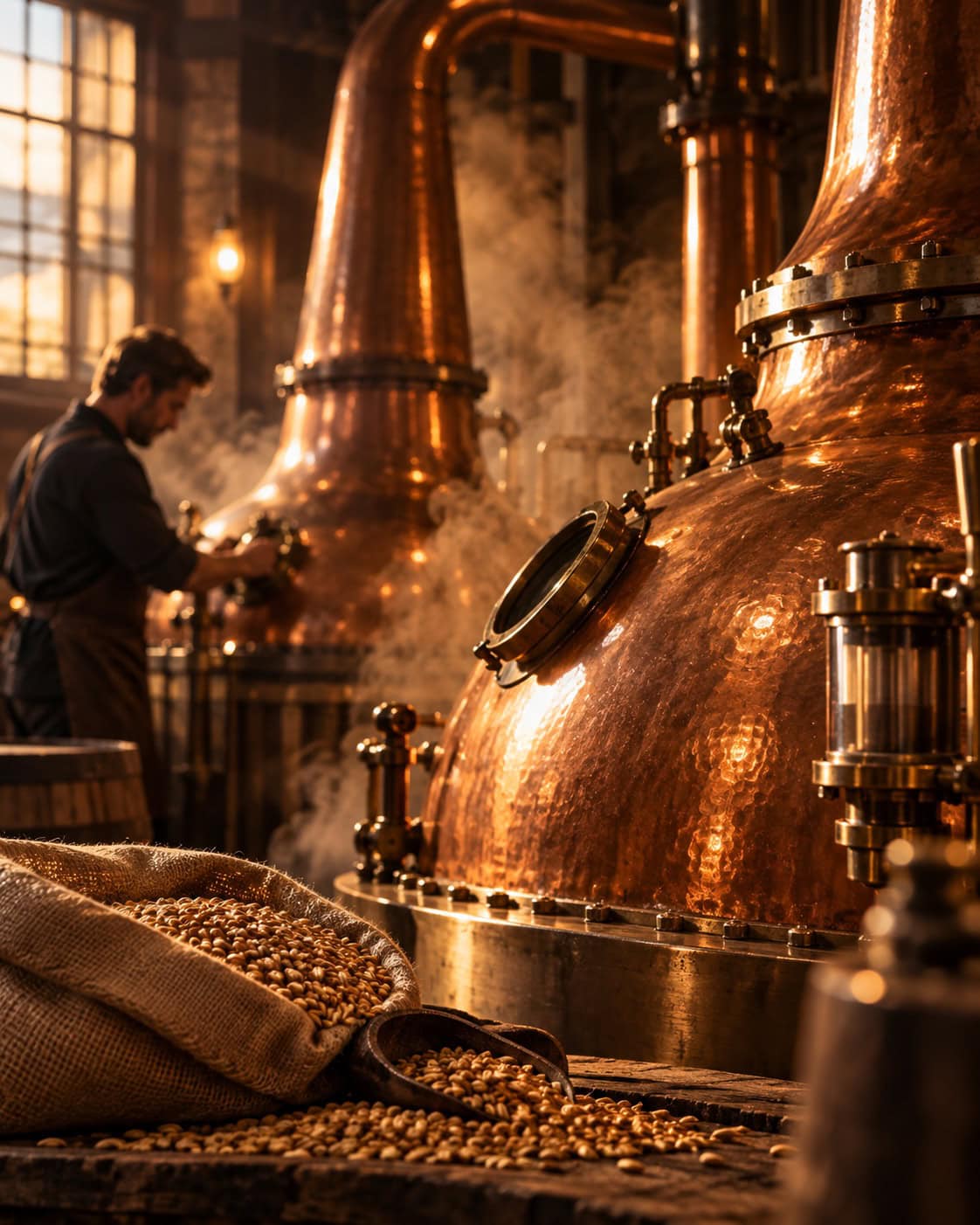
Distillation concentrates the alcohol and flavours contained in the wash. For Scotch single malt, the wash is heated in copper pot stills. Alcohol vapours rise through the neck of the still, travel along the lyne arm and are then cooled in a condenser, turning them back into liquid.
Most Scotch single malt is distilled twice, although there are exceptions. Triple distillation has traditionally been more closely associated with Irish whiskey, but plenty of Irish producers distil twice too.
Grain whisky and most bourbon are instead produced using column stills, which can operate continuously rather than processing one batch at a time. Different equipment, ingredients and techniques all play their part, but the basic goal remains the same: turning a fermented cereal wash into the spirit that will eventually become whisky.